
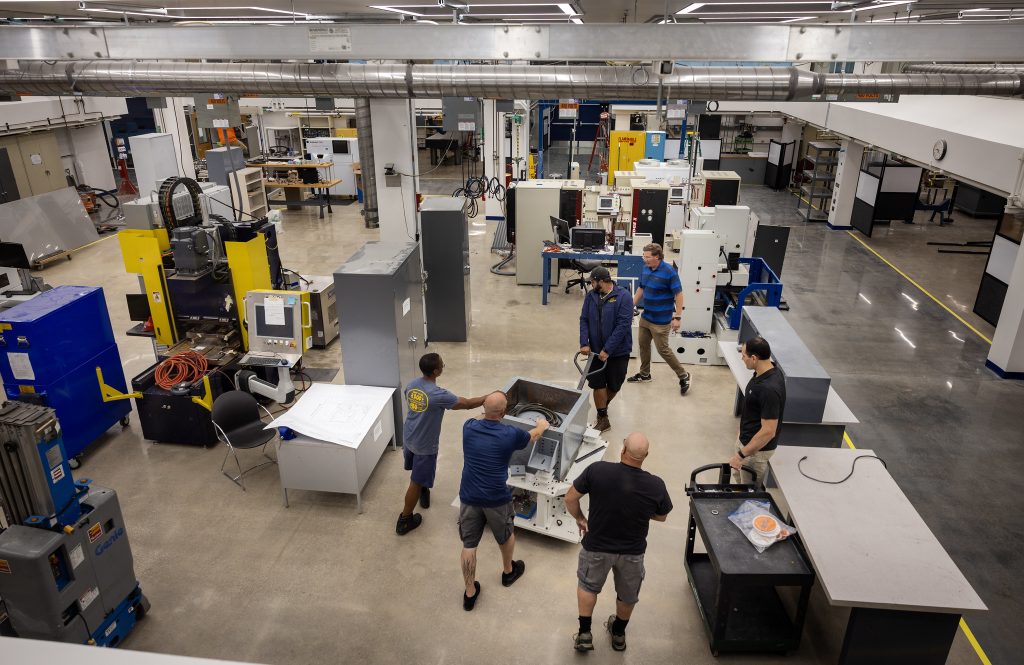
Tucked behind familiar lecture halls, Room 1100 of the Herbert H. Dow Building has found renewed life as a hub for advanced manufacturing research and learning. Once easy to overlook, the space now features cutting-edge tools and collaborative work areas thanks to a recent renovation managed by U-M’s Facilities & Operations (F&O) in close partnership with the College of Engineering.
A space with history and a forward-looking purpose
Since the Dow Building opened in 1982, Room 1100 has continually adapted to serve North Campus. It has operated as the area’s primary library, supported early work in reconfigurable manufacturing systems, and later housed research in lightweight materials in collaboration with partners such as Detroit’s Lightweight Innovations for Tomorrow (LIFT) Institute.
This most recent renovation, the first in 20 years, was shaped by Mechanical Engineering Professors Chinedum Okwudire, Daniel Cooper, and Albert Shih. Recognizing the growing need for modern additive manufacturing equipment and a space that could encourage cross-disciplinary collaboration, they helped define a new vision for the lab. F&O then worked closely with them to translate that vision into a functional, future-ready environment.
How AEC brings projects to life
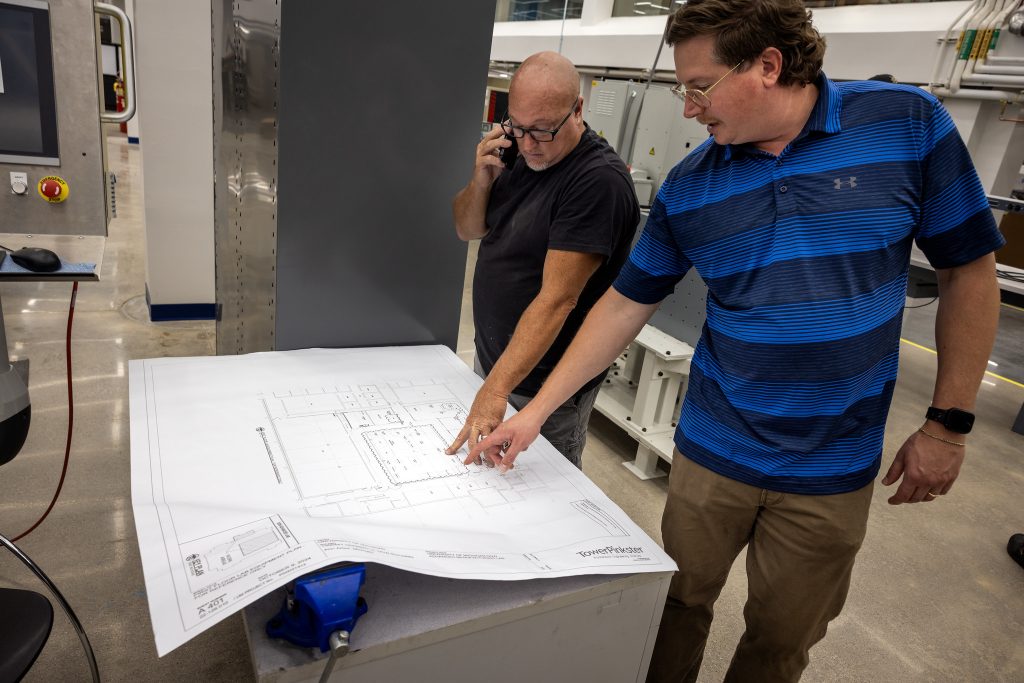
The renovation of Dow 1100 followed the standard project delivery process led by Facilities & Operations, Architecture, Engineering and Construction (AEC), which guides campus projects from the earliest idea through full occupancy. The effort began when faculty identified the need for updated research space and partnered with AEC to define goals, scope, budget, and timeline through early stakeholder meetings with researchers, building managers, and technical experts.
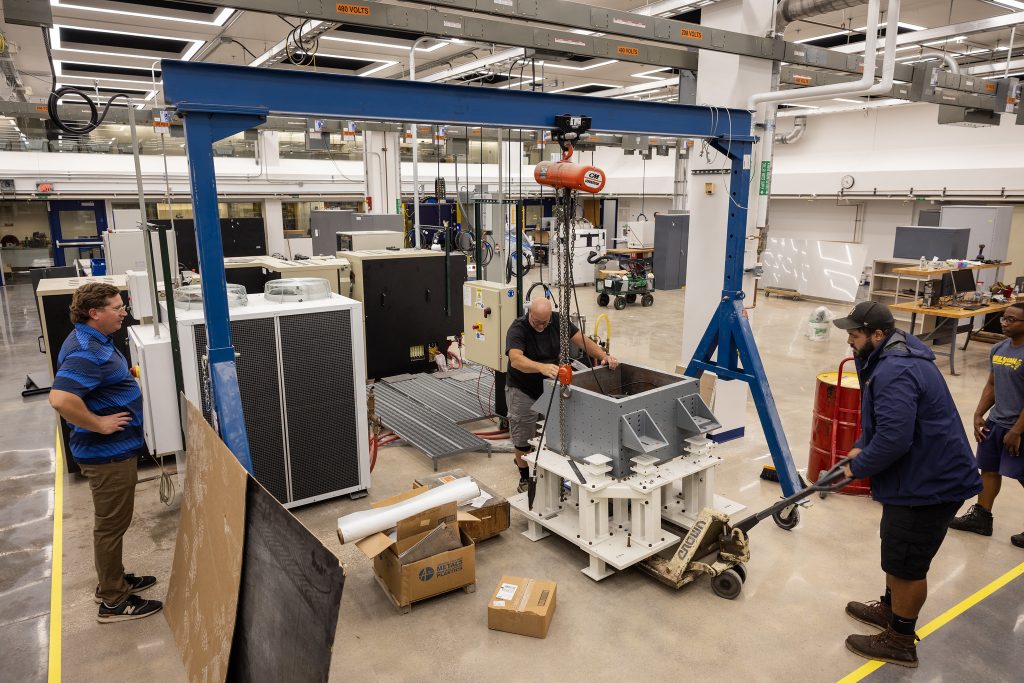
Once the project was initiated, AEC assigned a project manager, budget analyst, design manager, and brought in architects Tower Pinkster, general contractor Albert Higley, and engineers through a competitive selection process to support the lab’s specialized needs. Together, the team moved through conceptual and schematic design, refining layout options and addressing complex mechanical, electrical, and safety requirements before advancing into detailed design development and design reviews involving Facilities & Operations, Environment, Health & Safety, the U-M Fire Marshal, and other campus partners. During construction, AEC coordinated contractors, oversaw progress, and worked closely with on-campus partners such as DPSS, ITS, EHS, Lab Safety, and Moving & Trucking, while commissioning agents rigorously tested building systems to ensure readiness.
“Dow was originally designed as a library, not a research lab,” said Jana Hayford, AEC Design Manager. “The original use of the space brought unique challenges to the design process.”
While previous projects addressed upgrades in the space including new air-handling systems and modernized lighting, this project focused on designing within the existing mechanical system while still improving functionality, enhancing safety features, and honoring campus traditions, including the careful placement of the Block M.
“It truly was a puzzle, making sure every piece of equipment had the right power, exhaust, and space,” Hayford said. “We even made sure the Block M in the floor was placed so that it would not be stepped on.”
Built for collaboration, safety, and hands-on learning
The renovated lab features an open design that supports both research and teaching. It includes shared additive manufacturing equipment including state-of-the-art 3D printers and metrology tools, along with flexible workspaces for faculty members and a connected undergraduate classroom. Graduate students have a secure, card-access area, and a large robot station is enclosed with safety fencing to support hands-on experimentation.
Faculty and students work side-by-side with grant-funded technologies, and each lab group receives customized safety training. Posters throughout the space highlight ongoing projects, making the lab not only functional but also a showcase of U-M’s innovation.
Facilities & Operations: Supporting research at every step
From early needs assessments to final commissioning, F&O supports every phase of research infrastructure on campus including budgeting, engineering, design, and regent approvals.
“Our goal is always to help researchers and students do their best work,” Hayford said.
With construction now complete, Dow 1100 begins a new chapter in Michigan’s manufacturing story. What was once a quiet corner of the building is now filled with the hum of new machines, and with it, new possibilities for learning, discovery, and innovation.
“From the contractors to the project team, everyone worked together to take this renovation over the finish line,” said Matt Jastrzembowski, Building Manager. “It’s a huge upgrade for our students and faculty.”